
Most Sydney businesses know they should be reducing waste.
The hard part is turning that intent into a useful waste audit: this is one that produces reliable data, clear actions, and measurable savings.
What’s more, it is crucial that it suggests methods that are approved waste management processes as well as provides waste reporting and ongoing support.
Our experience in the waste management industry have shown how, too often, audits become a time consuming box tick, with inconsistent methods, unclear scopes, and reports that never translate into operational change.
So in this guide, we’ll unpack the real “waste auditing dilemma” for Sydney businesses and share a practical, proportionate approach to getting results, without disrupting operations or wasting budget.
Why waste auditing matter for Sydney businesses (even those not interested in cost efficiency)
A waste audit is a structured review of what your site throws away (and in what quantities).
Done properly, we’ve learnt that it helps you move from assumptions (“our bins are always full”) to decisions backed by evidence (“general waste is 60% food, 25% cardboard, 15% mixed”).
It can also lead to lower waste management costs and generally better waste education for your company’s employees.
What a good audit can unlock
- Lower waste costs: identify avoidable general waste volume, rightsize bin services, and reduce collection frequency where appropriate.
- Improved diversion rates: increase recycling and organics capture by targeting the biggest opportunities first.
- Stronger sustainability reporting: build defensible metrics (weights, diversion rate, contamination %) instead of relying on estimates.
- Local program alignment: support participation and reporting where relevant (e.g., NSW programs and council waste targets).
If you’re looking for a starting point, the NSW EPA’s free Bin Trim program is a practical way to benchmark waste and uncover quick wins before you invest in deeper auditing.
The waste audit Sydney businesses ask for vs. what they actually need
Many businesses request “a waste audit” as if it’s one standard service. In reality, auditing can range from quick reconciliation of bin weights through to full manual sorting into 20–30 material categories.
In short, it can do far more than just tally waste generated and recommend vague waste diversion or resource recovery.
The dilemma
- You need actionable insights and credible data.
- You don’t want a disruptive, labou rintensive exercise that drains staff time.
- You want recommendations that can actually be implemented—then measured.
The solution is rarely “go bigger.” It’s choosing the right scope, using repeatable measurements, and building implementation into the plan from day one.
Common barriers Sydney businesses face during waste audits
Our experience has taught us that the most common reasons waste audits stall or underperform, especially for small-to-medium Australian operators and multisite businesses in the Sydney metropole.
1) Time, staffing, and budget constraints
Full onsite sorting audits can require multiple visits, specialised labour, and disruption to normal waste handling. For many sites, that level of effort isn’t proportionate to the outcome, particularly if you’re still building a baseline.
2) Confusing services and jargon in the local market
“Bin reconciliation,” “visual audit,” “weight audit,” “WMP” (Waste Management Plan), “contamination assessment”— some providers may use different terms for similar activities, or similar terms for different scopes. That makes it difficult to compare quotes or assess value. Not ideal, but how some in the industry function.
3) Data reliability problems (and inconsistent methodology)
Sometimes one off visual checks can be misleading: a “full” bin doesn’t equal a “heavy” bin, and different waste streams vary dramatically in density. If your methodology changes between audits (or between providers), it’s hard to track progress over time.
4) High contamination and mixed streams
Recyclables mixed with food waste, soft plastics in commingled bins, liquids in general wast, where contamination can skew results and add a slew of unwanted complexity. But we’ve learnt that it may also signal that the real fix is operational (bin placement, signage, training), not just more measurement.
5) Multisite and multistream complexity
Businesses with several locations—or varied waste streams like food organics, packaging, e waste, and regulated materials—face coordination issues. Without standardised processes, each site produces different outcomes, which complicates reporting and procurement.
6) Regulatory and program uncertainty
Waste rules, local council requirements, and NSW programs can be difficult to interpret in practical terms. An audit that doesn’t translate findings into compliant, site ready changes often ends up as a report that sits on a shelf.
Why a poor waste audit can be worse than no audit
A weak audit doesn’t just fail to help. We think that it can actively steer your business in the wrong direction when it comes to waste management practices.
Risks of superficial audits and waste management
- False confidence: KPIs built on unreliable estimates can make performance look better (or worse) than it really is.
- Misallocated spend: you might invest in the wrong bin system, signage, or collection schedule.
- Lost momentum: staff disengage when they’re asked to change behaviours without clear feedback or results.
In most workplaces, the real cost of a poor audit is opportunity: months of effort with no measurable reduction in general waste weight or contamination.
How to choose the right type of waste audit in Sydney (light, medium, or full)
The best waste audit is the one that matches your goals, risk profile, and day-to-day operations. Choosing the right scope ensures you get useful insights without over or underinvesting in analysis.
Lighttouch audit (fast baseline and cost focus)
A light touch audit is best for businesses looking for quick savings and a clear starting point.
It focuses on understanding whether current waste services align with actual needs by reconciling bins and collection services, reviewing lift frequency, bin size, and overflow patterns, and tracking weights over a short, defined period such as one to four weeks.
This approach provides a rapid baseline and often identifies immediate cost and efficiency wins.
Medium audit (targeted stream deepdive)
A medium audit suits sites with a known problem stream, commonly food waste, cardboard, or mixed recycling contamination.
It involves targeted sorting of one or two waste streams to understand what is really going into them, combined with a contamination assessment and practical fixes such as improved bin placement, clearer signage, or staff training.
The outcome is a set of recommendations with measurable targets, including diversion rates and contamination percentages.
Full sorting audit (rigorous baseline and behaviourchange programs)
A full sorting audit is designed for multisite rollouts, formal sustainability reporting, or major operational change.
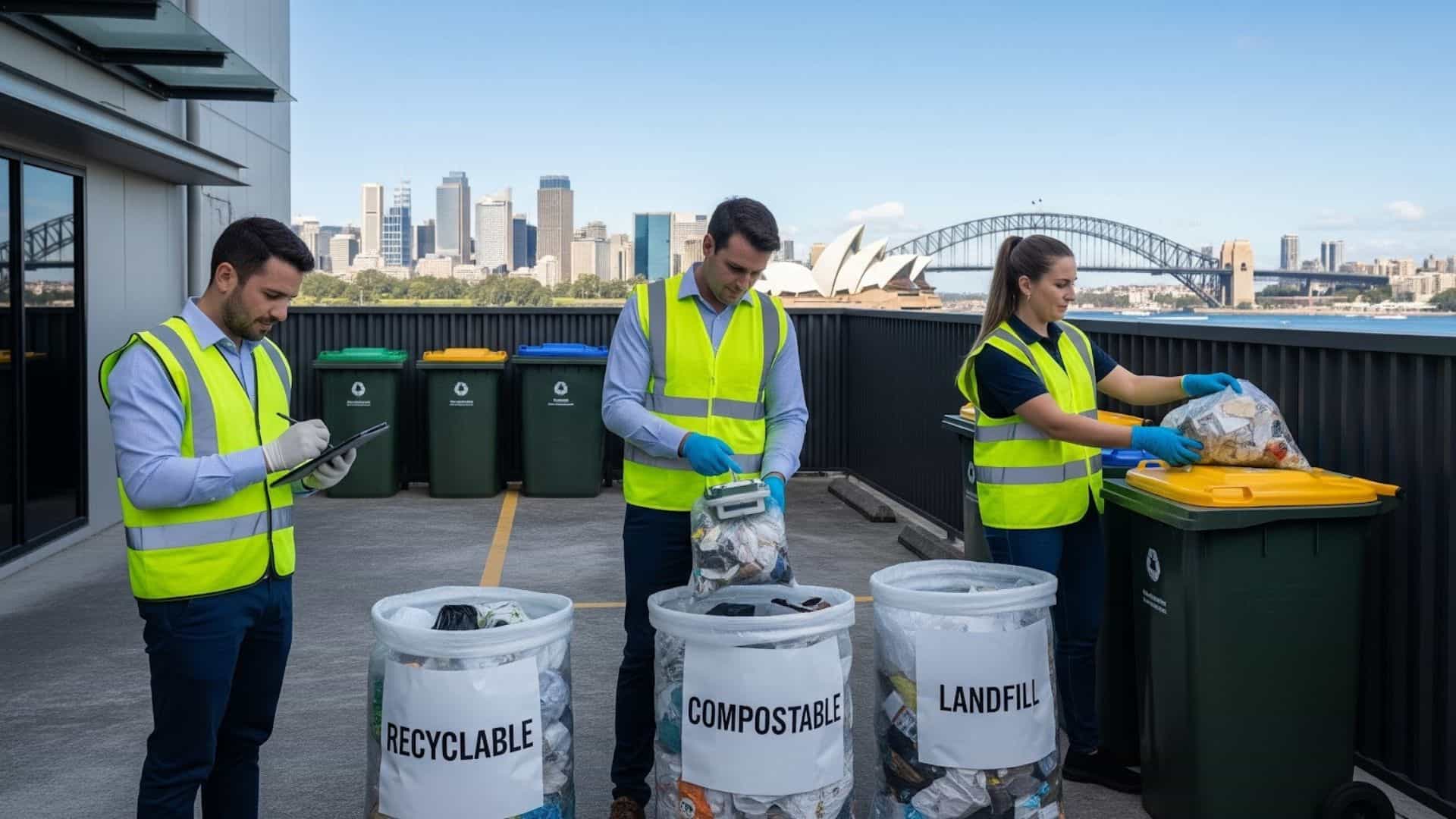
It involves manual sorting into 20–30 categories, depending on the site, with detailed weighing and recording of each category.
The results are compiled into formal reports suitable for ongoing governance, benchmarking, and performance tracking over time.
As a rule, repeatable, weight based measurements deliver far more value than one off visual observations, especially if you want to compare performance quarter to quarter and track real improvement.
A practical and proportionate waste audit process (Sydney ready)
Waste auditing throughout the years has taught us some useful approaches to the process. We’re sharing them below for all who want to attempt to do one themselves, but we still highly recommend contacting an expert like us at Cleanway.
So if you want an audit that delivers outcomes—not just data—use this workflow to keep it focused and repeatable.
Step 1: Define the goal in one sentence
- Reduce waste cost (collection and disposal)
- Improve recycling/organics diversion
- Support ESG/sustainability reporting
- Meet site or contract compliance requirements
Step 2: Establish a baseline using simple, consistent data
- Track bin weights (or volume and lift frequency where weights aren’t available) for 2–4 weeks.
- Record service details: bin size, stream type, pickup schedule, and overflow incidents.
- Use free tools like NSW EPA Bin Trim to structure your baseline.
Step 3: Choose the smallest audit scope that answers your question
- If your question is “Are we overpaying for general waste?” start with reconciliation and weights.
- If your question is “Why is recycling being rejected?” do a targeted contamination sort.
- If your question is “What’s our true waste footprint across multiple sites?” plan a staged full audit starting with a pilot site.
Step 4: Pilot one site or one stream first
For Sydney multisite businesses, we suggest you try start with a representative or highest volume location.
For single site operators, start with the biggest stream (commonly general waste or organics in hospitality, and cardboard/packaging in retail and warehousing).
Step 5: Build implementation into the plan
- Staff toolbox training (short, rolespecific)
- Clear signage (simple language, pictures where helpful)
- Bin placement changes (make the right choice the easy choice)
- A followup check at 3–6 months to confirm improvements
How to compare waste audit providers in Sydney (what to ask for)
Not all audits are equal. Before you approve a quote, ask for clarity on methodology and deliverables—so you can compare providers fairly.
Provider checklist (use this in your quote process)
- Method: Is it visual, weight based, reconciliation, sorting, or hybrid?
- Repeatability: Can the same method be used again in three, six, and 12 months?
- KPIs: Will they report weights, diversion rate, and contamination % (not just observations)?
- Scope clarity: What streams are included (general, commingled, cardboard, organics, ewaste)?
- Deliverables: Do you get a roadmap with prioritised actions, owners, timeframes, and estimated payback?
- Implementation support: Is training, signage, and follow up included—or optional?
- Local experience: Can they show examples relevant to Sydney/NSW operations?
Tip: Don’t just compare total price. I’d recommend you rather compare what changes on site and how improvement is measured.
When your audit involves regulated or hazardous waste
Some streams require specialist handling and strict compliance controls. If your site generates regulated materials (for example, certain chemicals, contaminated absorbents, or other hazardous wastes), the audit approach should prioritise safety, lawful handling, and traceability.
What to do (and what not to do)
- Do: identify hazardous streams at a high level and ensure they’re managed through appropriate licensed services and documentation.
- Do: ensure chainofcustody and compliant transport and disposal processes are in place.
- Don’t: ask staff to handle unknown or hazardous materials as part of an informal “sorting exercise”. Engage qualified professionals.
If you need support across complex or regulated waste streams, Cleanway can help you structure an audit approach that’s practical and compliance led. Learn more at Cleanway.
Three Sydney style examples of proportionate waste audits
Example 1: Small café (quick wins without disruption)
- Start with Bin Trim and four weeks of weekly bin weights (general and food).
- Run a targeted organics assessment to identify the biggest contamination sources.
- Introduce a foodorganics service and short staff training.
- Recheck in three months to confirm general waste weight reduction.
Example 2: Multisite retailer (pilot then standardise)
- Pilot the highest volume store with reconciliation + a targeted sort.
- Standardise bin types, colours, and signage across sites.
- Track monthly weights by stream to prove improvement over time.
Example 3: Hospitality or event venue (stakeholder ready reporting)
- Audit around an event window with clear measurement boundaries.
- Report diversion and contamination rates with practical operational recommendations.
- Use results for internal reporting and stakeholder communications.
Quick checklist: how to get a useful waste audit in Sydney
- Define your goal: cost reduction, compliance, sustainability reporting, or diversion targets.
- Baseline first: capture 2–4 weeks of weights/collections before changing anything.
- Choose the right depth: light (reconciliation/weights), medium (targeted sort), or full (multicategory manual sort).
- Compare 2–3 quotes: ask for sample reports and methodology details.
- Insist on repeatable metrics: weights, diversion rate, contamination %.
- Budget for behaviour change: training, signage, and bin placement improvements.
- Schedule a follow up: remeasure at 3–6 months to confirm results.
Closing thoughts
The most effective waste audit Sydney businesses can run isn’t always the biggest or most expensive; it’s the one that produces repeatable data and implementable actions. Start with a practical baseline, focus on the biggest waste stream first, and build in follow up measurement so improvements stick.
If you want an audit approach that’s safety led, compliance focused, and designed to deliver operational outcomes, talk to Cleanway about a proportionate waste audit and waste management plan.